Regular Hexadecagon out of Square Paper
Sixteen sides is a strange, lovely number. Cut a square eight times and you get an octagon; push it all the way toward a circle and you land on the hexadecagon — the polygon that makes sixteen-petal flowers feel generous instead of crowded.
The folding here reads like a quiet conversation with your paper. You begin with a familiar square base, turn it so the opening faces you, then coax the corners inward with a vertical fold and layer the next folds over the frontmost sheets. Nothing about it is rushed: each step is a photograph, and the repetition builds a rhythm of its own. The payoff arrives at the end, when one small cut along the dotted line sheds the excess and the opened sheet turns out to be perfectly, satisfyingly sixteen-sided.

If you want to make a flower with sixteen petals, you need paper in a regular hexadecagon shape instead of a square. This page shows how to make an origami regular hexadecagon from a square sheet.
In this instruction, I used 15cm x 15cm origami paper. Of course, the folding method is independent of paper size.
This is the front side of an origami paper.
This is the back side of an origami paper.
STEP 1.
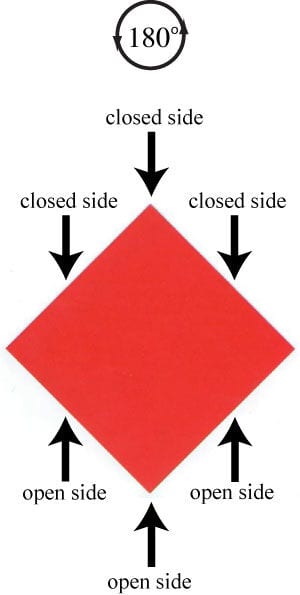
Start with a “square base”. Prepare to rotate the base by 180 degrees so that the top becomes the open side.
STEP 2.
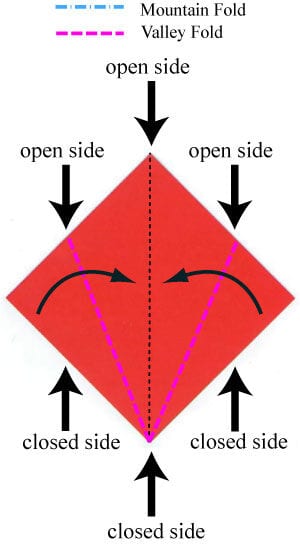
Rotate the base by 180 degrees so that the top becomes the open side. Prepare to apply two valley-folds.
STEP 3.
Apply the two valley-folds of step 2. Prepare to turn the model over.
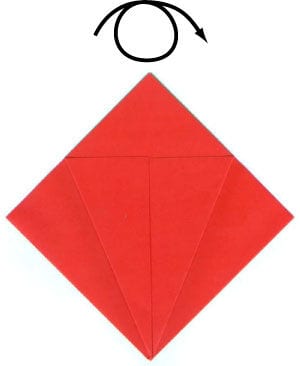
STEP 4.
Turn the model over. Prepare to apply two valley-folds.
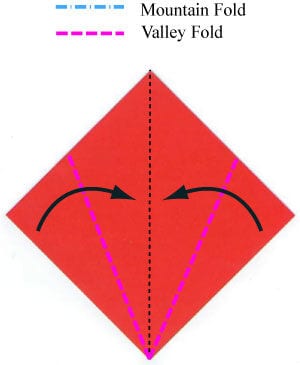
STEP 5.
Apply the two valley-folds of step 4. Prepare to apply a vertical valley-fold.
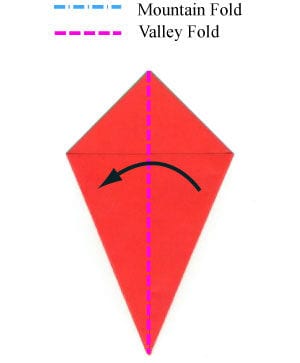
STEP 6.
Apply the vertical valley-fold of step 5. Prepare to turn the model over.
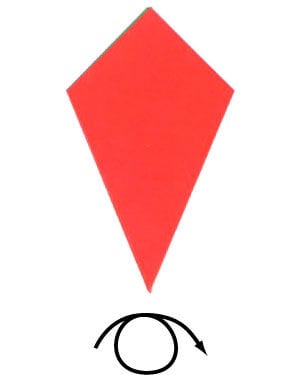
STEP 7.
Turn the model over. Prepare to apply a vertical valley-fold.
STEP 8.
Apply the vertical valley-fold of step 7. Prepare to apply two valley-folds on the frontmost layer.
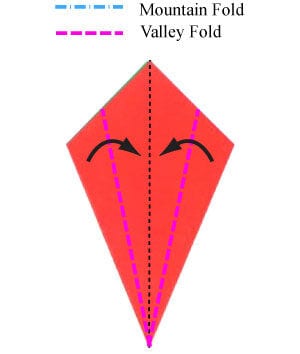
STEP 9.
Apply the two valley-folds on the frontmost layer. Prepare to apply two more valley-folds.
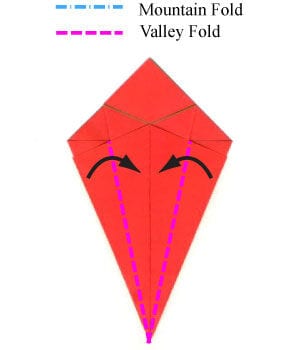
STEP 10.
Apply the two valley-folds of step 9. Prepare to turn the model over.
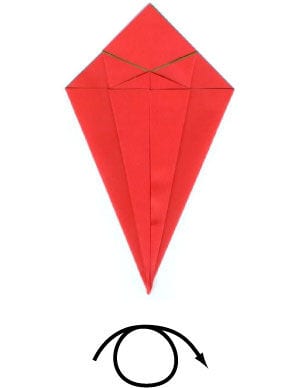
STEP 11.
Turn the model over. Prepare to apply two valley-folds on the frontmost layer.
STEP 12.
Apply the two valley-folds on the frontmost layer. Prepare to apply two valley-folds.
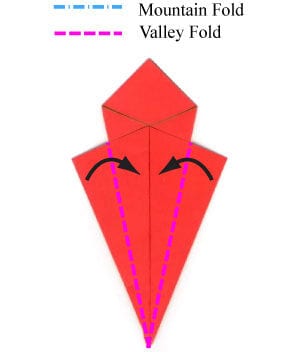
STEP 13.
Apply the two valley-folds of step 12.

STEP 14.
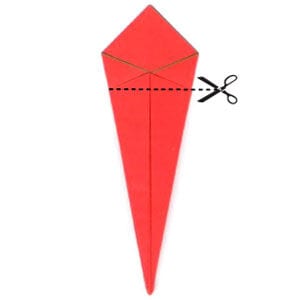
Prepare to cut the paper off along the dotted line.
STEP 15.
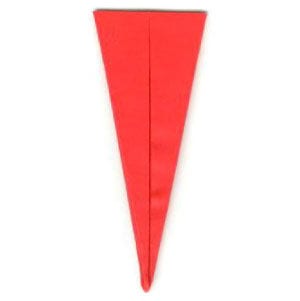
Cut the paper off along the dotted line of step 14.
STEP 16.
Open the paper. Congratulations! You have completed making a regular hexadecagon.